Case study
SecOps Dashboard
A self-hosted workspace for turning scattered scanner findings into investigation, ownership, and follow-through.
Independent project · Open source · MIT License
The problem
Findings need a workflow after the scan.
A report can identify a problem without establishing who will investigate it, whether it duplicates an existing finding, or how the fix will be tracked. I built SecOps Dashboard to connect those steps in one workspace.
- My work
- Application design, API and frontend implementation, security controls, tests, and deployment tooling.
- What you can inspect
- Public source, tagged releases, a threat model, and documented operating procedures.
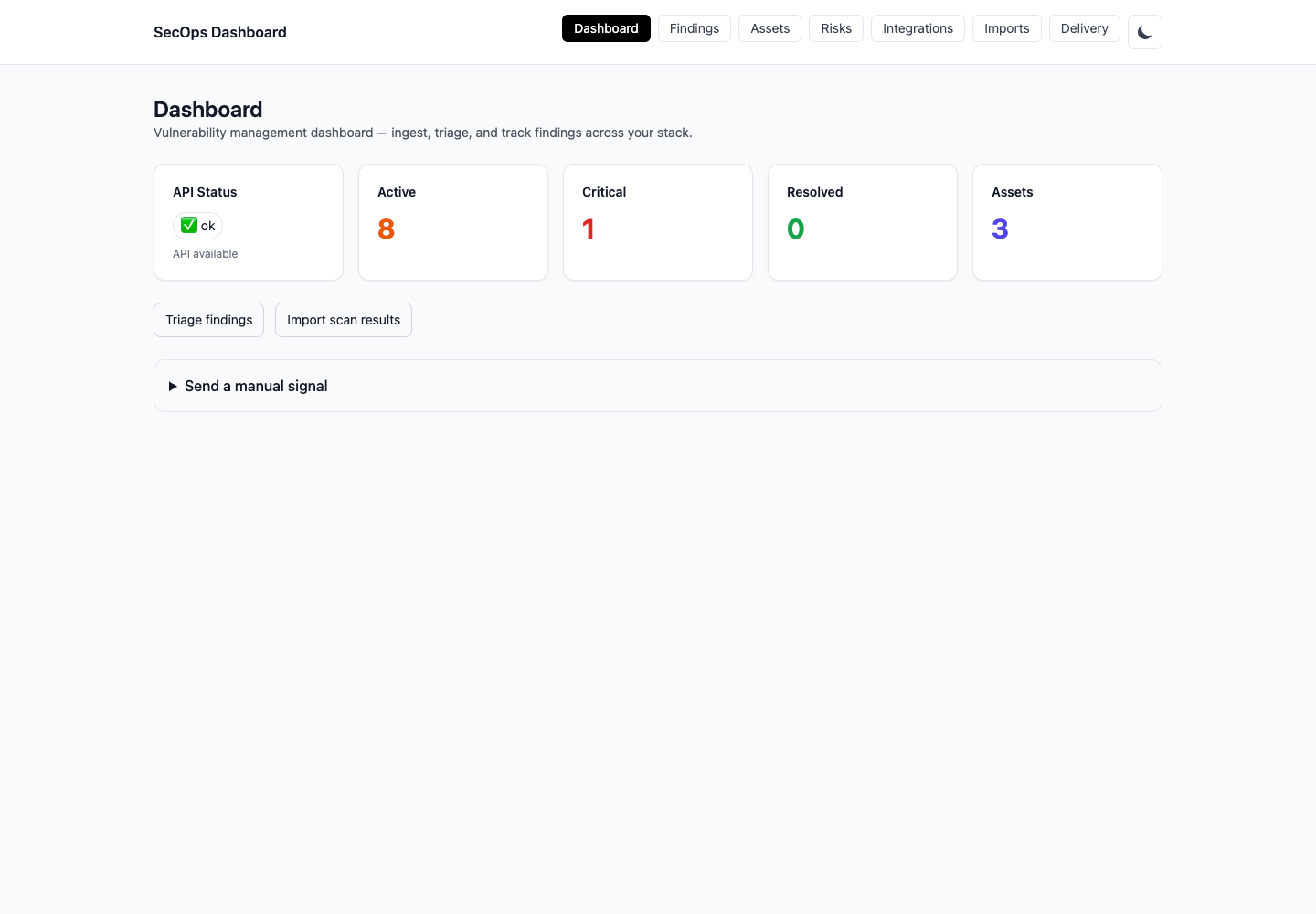
Interactive sample · Synthetic data
Take a finding from signal to action.
Filter the sample findings, inspect the evidence, then update the status or owner. Changes stay in this page and reset when you reload.
- 01 Filter
- 02 Investigate
- 03 Triage
These examples describe the sample workflow. Enable JavaScript to try filtering and triage.
Unparameterized query in checkout API · Critical
A sample query combines request text with a database statement. Confirm that the code path is reachable and that the input is untrusted.
Next action: Use parameterized queries and verify the change with regression cases for untrusted input.
Container dependency needs review · High
The sample report flags an outdated package in a worker image. A version match is a lead; the affected behavior still needs a reachability review.
Next action: Review the affected dependency path, update the image where appropriate, and scan the rebuilt artifact.
Storage bucket allows public reads · High
An example storage policy permits anonymous reads. Establish whether the bucket contents are intended to be public before changing access.
Next action: Remove unintended public access, verify the application still works, and add a policy check for recurrence.
Session cookie missing Secure flag · Medium
The synthetic response sets a session cookie without the Secure attribute. Review the application's HTTPS and cookie configuration together.
Next action: Set Secure for the session cookie and verify login, logout, and session renewal over HTTPS.
Debug header disclosed · Low
A sample response included a development-only header. In this scenario, a follow-up response confirms the header has been removed.
Next action: Keep development headers out of production responses and retain a regression check.
- Sample findings
- 5
- Open
- 3
- Investigating
- 1
- Resolved / closed
- 1
No findings match. Try a different search or filter.
- Scanner
- Project
- Occurrences
What the evidence says
Next action
Back to sample findingsChoose a finding to investigate.
Architecture
A visible path from import to follow-up.
Next.js
Findings, investigation, team workflows, and user sessions.
FastAPI
Scanner imports, normalization, identity, and project access checks.
PostgreSQL
Findings, accounts, sessions, activity, and queued notification jobs.
Notification worker
Deliver Slack and Jira jobs with retries and delivery-state review.
Browser requests reach the API through Next.js; scanner reports enter at the API. The worker reads queued jobs from the database. The local quickstart uses SQLite and disables external notifications.
Engineering decisions
The choices behind the interface.
Make imports explainable.
Enable scanner formats backed by representative fixtures, record import outcomes, and use project and component evidence when identifying duplicate findings.
Trade-off: incomplete context can produce a distinct finding. The application avoids guessing how to merge historical records.
Enforce scope at the API.
Use individual accounts, roles, and project grants. Check access on reads and writes, including saved views, exports, and bulk triage.
Trade-off: this is a deployment for one trusted team. Project grants are not isolation between separate organizations.
Treat scanner text as untrusted.
Keep administrative credentials out of the frontend, omit raw scan payloads by default, and neutralize formula-like cells in CSV exports.
Trade-off: targeted redaction helps limit exposure, but operators still control access, retention, and backups.
Keep failures reviewable.
Persist notification jobs, record delivery state, and provide bounded retries. Apply migrations and document backup, restore, and account recovery.
Trade-off: an interrupted external request can have an uncertain outcome that needs review before retrying.
Inspect the work
Code, decisions, and a way to run it.
The case study covers the core workflow and team controls shipped in v0.2.0. The repository tracks subsequent development.
- Local quickstart Start a local instance and load synthetic findings.
- v0.2.0 release Published scope and team workflow changes.
- Threat model Trust boundaries, abuse cases, and remaining risks.
- Operations runbook Deployment, migrations, backup, and recovery.